
How to Choose Cannabis Flower: A Beginner’s Buying Guide
Shopping for cannabis flower can feel surprisingly complicated.
Indica or sativa? What does 25% THC actually tell you? Are more trichomes better? What are terpenes? And what exactly do terms like smalls, AAA and AAAA mean?
While there’s no single cannabis flower that’s right for everyone, understanding a few basic characteristics can make comparing different options much easier.
Here are some of the things to look at when evaluating cannabis flower.
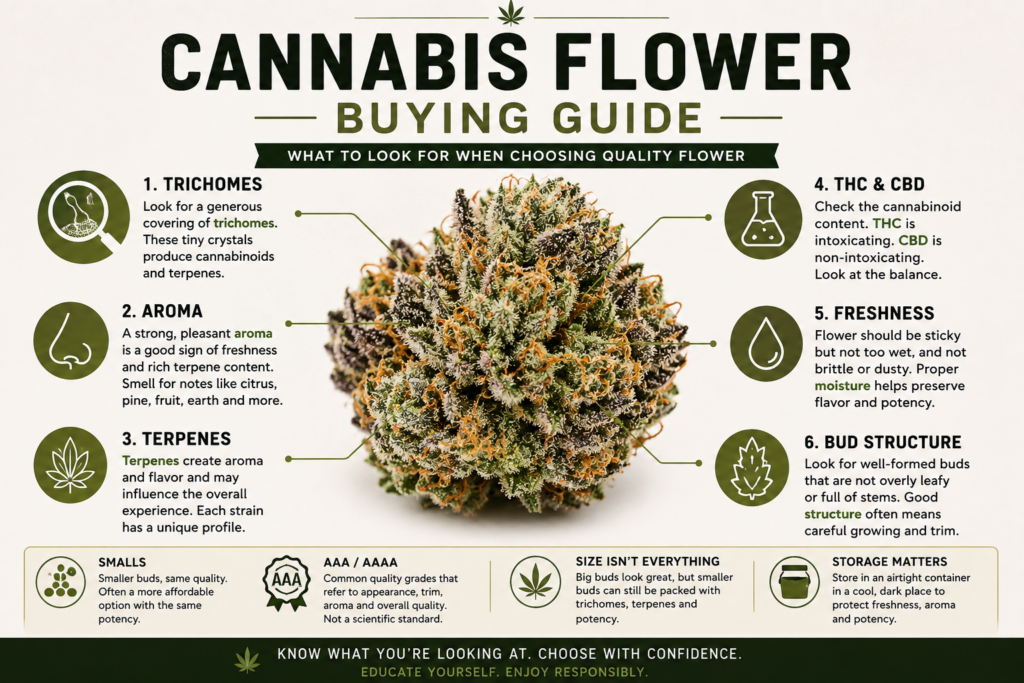
1. Start With the Flower Itself
Appearance isn’t everything, but it can tell you quite a bit about how cannabis flower was grown, handled and stored.
Healthy dried cannabis flower can vary dramatically in appearance depending on its genetics. You’ll see different shades of green along with possible purple, orange and other colours.
Rather than judging flower solely by colour, look at its overall condition.
You generally want buds that look intact rather than completely crushed or excessively dry and powdery.
Then look a little closer.
2. Look at the Trichomes
That frosty, crystal-like coating you see on cannabis flower isn’t actually frost.
Those tiny structures are called trichomes.
Glandular trichomes produce and store many of the compounds associated with cannabis, including cannabinoids and terpenes.
A generous covering of visible trichomes can therefore be one characteristic people look for when examining cannabis flower.
However, appearance alone can’t tell you the exact cannabinoid content or overall quality of a product.
Want to see what’s happening at the microscopic level? Read our What Are Cannabis Trichomes? guide.
3. Pay Attention to Aroma
Aroma is another noticeable characteristic of cannabis flower.
Different varieties can smell:
- Citrus
- Fruity
- Sweet
- Piney
- Earthy
- Floral
- Herbal
- Peppery
- Spicy
- Fuel-like
Much of this aromatic diversity comes from compounds called terpenes, along with other volatile compounds produced by the plant.
A strong aroma isn’t automatically proof that cannabis is better, but aroma can tell you something about the characteristics and freshness of the flower.
Learn more in our What Are Terpenes in Cannabis? guide.
4. Check THC and CBD Content
THC percentage gets a lot of attention when people compare cannabis flower, but it shouldn’t necessarily be the only number you look at.
THC (tetrahydrocannabinol) is the primary intoxicating cannabinoid in cannabis.
CBD (cannabidiol) does not produce the same intoxicating high as THC.
Cannabis flower can contain different concentrations and ratios of these cannabinoids.
Most importantly, higher THC doesn’t automatically mean higher-quality flower.
Potency and quality aren’t the same measurement.
For a deeper explanation, see our THC vs. CBD: What’s the Difference? guide.
5. Don’t Rely Only on Indica vs. Sativa
Indica and sativa are probably the most recognizable cannabis categories.
You’ll commonly see flower described as:
Indica
Sativa
Hybrid
These labels can be useful for organizing products, but they don’t provide a complete description of a flower’s chemical composition or reliably tell you exactly how a particular product will affect you.
Cannabinoid concentration, terpene profile, individual biology, dose and other factors can all matter.
That’s why it’s worth looking beyond the name on the label.
Our Indica vs. Sativa: What’s the Difference? article explains this in more detail.
6. Look at Freshness and Moisture
Properly stored cannabis flower shouldn’t crumble into dust the moment it’s touched, but it also shouldn’t feel excessively wet.
Very dry flower can become brittle, lose aroma and burn quickly.
Excessive moisture, meanwhile, can create storage problems and increase the risk of microbial growth.
Good storage matters too.
Cannabis should generally be kept in an airtight container away from excessive heat, light and moisture.
We’ll cover this in more detail in our upcoming How to Store Cannabis Flower guide.
7. What Does “Smalls” Mean?
You’ve probably seen cannabis labelled smalls or small buds.
Smalls are simply smaller cannabis buds.
They may come from lower portions of the plant or be separated from larger buds during trimming and packaging.
Their smaller appearance doesn’t automatically mean they contain different cannabinoids from larger buds of the same batch.
Because appearance is a major part of how cannabis flower is marketed, smalls are sometimes offered at a lower price than larger, more visually impressive buds.
For someone more concerned with value than bud size, that distinction can be useful to understand.
8. What Do AAA and AAAA Mean?
You’ll also see terms such as:
AA
AAA
AAAA
These are informal grading terms commonly used in parts of the cannabis market.
They are not a universal scientific grading system, so one seller’s “AAAA” isn’t necessarily identical to another seller’s “AAAA.”
Generally, these labels are intended to communicate differences in characteristics such as appearance, trim, aroma, bud structure and overall perceived quality.
Instead of relying entirely on a grade, consider the actual characteristics of the flower.
9. Bigger Buds Don’t Automatically Mean Better Cannabis
Large, perfectly shaped buds certainly photograph well.
But size alone doesn’t determine cannabinoid concentration, terpene profile or overall quality.
Smaller buds from the same plant can still contain trichomes, cannabinoids and terpenes.
When comparing flower, look at the complete picture rather than judging it solely by bud size.
10. Learn to Read the Information, Not Just the Strain Name
Strain names can be fun and useful for identifying cannabis varieties, but the name alone doesn’t tell you everything about what’s inside the flower.
When information is available, look at:
- THC and CBD content
- Terpene information
- Appearance and trichomes
- Aroma
- Freshness
- Storage and packaging
- Product information
- Bud size and condition
The more you understand these characteristics, the easier it becomes to compare cannabis flower without relying solely on marketing terminology.
The Bottom Line
Choosing cannabis flower doesn’t have to come down to finding the highest THC percentage or the biggest bud.
Quality is more complicated than a single number.
Trichomes, cannabinoid content, terpene profile, freshness, aroma, storage and overall condition can all provide useful information about a cannabis product.
And terms like indica, sativa, hybrid, smalls, AAA and AAAA make a lot more sense once you understand what they actually describe—and what they don’t.
The goal isn’t to memorize every cannabis term.
It’s simply to know what you’re looking at.
Keep Learning
Continue with our Cannabis 101 guides:
What Are Cannabis Trichomes?
Learn about the tiny resin-producing structures covering cannabis flower.
What Are Terpenes in Cannabis?
Discover what contributes to the distinctive aromas of different cannabis varieties.
THC vs. CBD: What’s the Difference?
Understand two of the best-known cannabinoids found in cannabis.
Indica vs. Sativa: What’s the Difference?
Learn what these familiar cannabis categories actually tell you.